Lesson 12 Section1(git=go)
Gitmek (to go)
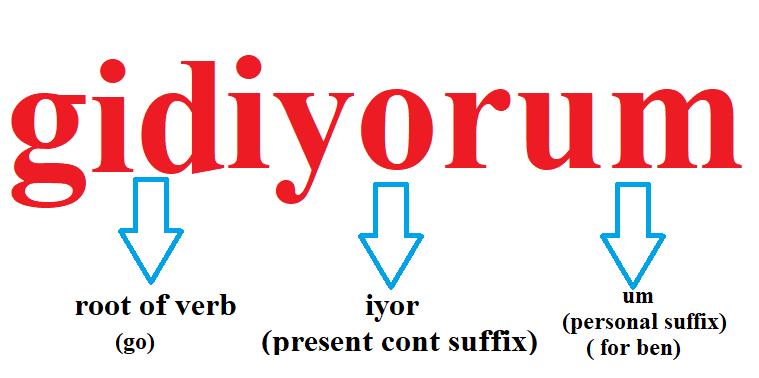
| Kişi (Türkçe) | Kişi (İngilizce) | Türkçe Çekim | Ayrımı | İngilizce Çeviri |
|---|---|---|---|---|
| Ben | I | gidiyorum | git (go) + iyor (present cont suffix) + um (personal suffix for Ben) | I am going |
| Sen | You (singular) | gidiyorsun | git (go) + iyor (present cont suffix) + sun (personal suffix for Sen) | You are going |
| O | He/She/It | gidiyor | git (go) + iyor (present cont suffix) | He/She/It is going |
| Biz | We | gidiyoruz | git (go) + iyor (present cont suffix) + uz (personal suffix for Biz) | We are going |
| Siz | You (plural/formal) | gidiyorsunuz | git (go) + iyor (present cont suffix) + sunuz (personal suffix for Siz) | You are going (plural/formal) |
| Onlar | They | gidiyorlar | git (go) + iyor (present cont suffix) + lar (personal suffix for Onlar) | They are going |

How can we form a question sentence for present tense in Turkish?
| Kişi (Person) | Soru (Question) | Olumlu Cevap (Affirmative Answer) | Olumsuz Cevap (Negative Answer) |
|---|---|---|---|
| Ben (I) | Sen eve gidiyor musun? (Are you going home?) | Evet, ben eve gidiyorum. (Yes, I am going home.) | Hayır, ben eve gitmiyorum. (No, I am not going home.) |
| Sen (You) | Ben eve gidiyor muyum? (Am I going home?) | Evet, sen eve gidiyorsun. (Yes, you are going home.) | Hayır, sen eve gitmiyorsun. (No, you are not going home.) |
| O (He/She/It) | O eve gidiyor mu? (Is he/she/it going home?) | Evet, o eve gidiyor. (Yes, he/she/it is going home.) | Hayır, o eve gitmiyor. (No, he/she/it is not going home.) |
| Biz (We) | Biz eve gidiyor muyuz? (Are we going home?) | Evet, biz eve gidiyoruz. (Yes, we are going home.) | Hayır, biz eve gitmiyoruz. (No, we are not going home.) |
| Siz (You – plural/formal) | Siz eve gidiyor musunuz? (Are you going home?) | Evet, siz eve gidiyorsunuz. (Yes, you are going home.) | Hayır, siz eve gitmiyorsunuz. (No, you are not going home.) |
| Onlar (They) | Onlar eve gidiyorlar mı? (Are they going home?) | Evet, onlar eve gidiyorlar. (Yes, they are going home.) | Hayır, onlar eve gitmiyorlar. (No, they are not going home.) |
How Many Types of Question Particles Are There in Turkish for the Present Tense, and How Are Questions Formed?
In Turkish, four types of question particles exist for the present tense: mi, mı, mu, mü. These particles are chosen based on vowel harmony, a fundamental rule in Turkish grammar. 90 percent of the time the ‘mu‘ suffix is used for present cont. tense.
Vowel Harmony and Question Particles:
- mi: Used when the last vowel of the word is an e or i (front unrounded vowels).
- mı: Used when the last vowel of the word is an a or ı (back unrounded vowels).
- mu: Used when the last vowel of the word is an o or u (back rounded vowels).
- mü: Used when the last vowel of the word is an ö or ü (front rounded vowels).
Steps to Form a Present Tense Question in Turkish:
- Start with the affirmative present tense sentence.
- Add the appropriate question particle (mi/mı/mu/mü) based on the vowel harmony of the sentence.
- Add the personal suffix (e.g., -um, -sun, -uz) to the question particle.
- Place the question particle after the verb (or auxiliary verb if applicable).
Examples of Present Tense Questions with English Translations
Example 1:
Verb: Gelmek (to come)
Sentence: Sen eve geliyor musun?
Structure:
gel (come) + iyor (present continuous suffix) + mu (question particle) + sun (you suffix)
English: Are you coming home?
Example 2:
Verb: Yazmak (to write)
Sentence: O mektup yazıyor mu?
Structure:
yaz (write) + ıyor (present continuous suffix) + mu (question particle)
English: Is he/she writing a letter?
Example 3:
Verb: Gitmek (to go)
Sentence: Biz okula gidiyor muyuz?
Structure:
git (go) + iyor (present continuous suffix) + mu (question particle) + yuz (we suffix)
English: Are we going to school?
Example 4:
Verb: Sevmek (to love)
Sentence: Siz kedileri seviyor musunuz?
Structure:
sev (love) + iyor (present continuous suffix) + mu (question particle) + sunuz (you plural suffix)
English: Do you love cats?
Example 5:
Verb: Okumak (to read)
Sentence: Onlar kitap okuyorlar mı? or Onlar kitap okuyor mu?
Structure:
- oku (read) + yor (present continuous suffix) + lar (they suffix) + mı (question particle)
English: Are they reading a book?
Key Notes:
- The question particle always comes after the verb.
- The choice of the question particle is strictly determined by the vowel harmony of the preceding word or suffix.
- Personal suffixes are mandatory in Turkish questions to indicate who is being addressed.
Summary:
Turkish has four question particles (mi, mı, mu, mü) that align with vowel harmony. To form a question, place the appropriate question particle and personal suffix after the verb. Examples above demonstrate this with detailed structures.