Turkish Lesson3-Section1(how can you say ”var mı?” in Turkish)
VAR MI ? = DO YOU HAVE?
How can you say ”var mı?” in Turkish
Grammar Explanation: “Senin araban var mı?” (Do you have a car?)
In Turkish, possession and existence are expressed using specific possessive suffixes and the words var (have/there is) and yok (don’t have/there isn’t). The question particle (mı, mi, mu, mü) is added according to vowel harmony rules.
English Explanation
Sentence Breakdown:
| Turkish | English | Explanation |
|---|---|---|
| Senin | Your | Indicates possession (“your”), showing that something belongs to the subject. |
| Araban | Your car | The base word araba (car) + the suffix -n for second-person possession (“your car”). |
| Var | Have / There is | Used to express existence or possession (“have” in this context). |
| Mı? | Question particle | Turns the sentence into a question. Chosen based on vowel harmony (last vowel in var is “a”). |
Positive and Negative Responses in Turkish
| Turkish | English |
|---|---|
| Evet, benim arabam var. | Yes, I have a car. |
| Hayır, benim arabam yok. | No, I don’t have a car. |
Word Usage Summary:
| Turkish | English | Meaning |
|---|---|---|
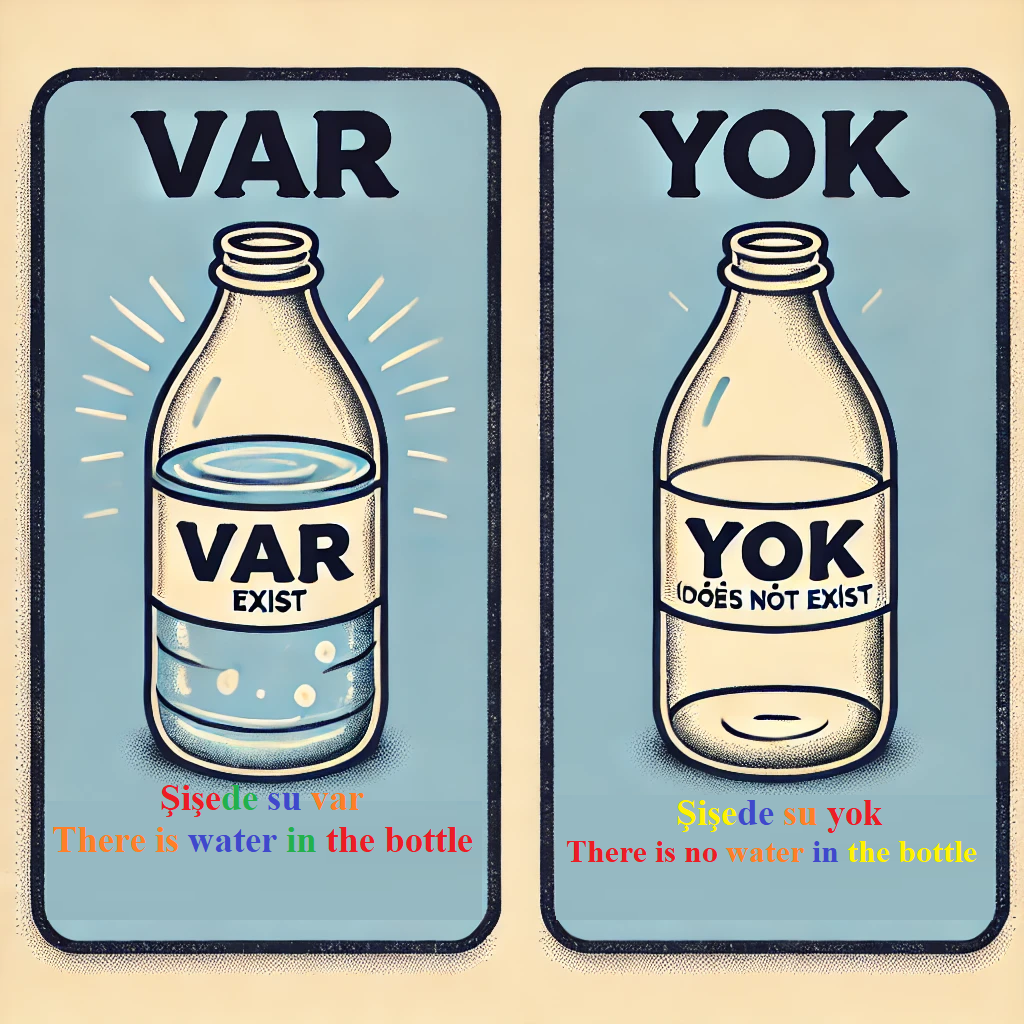
| Var | Have | Indicates possession/existence |
| Yok | Don’t have | Indicates lack of possession |
Questions About Possession in Turkish
In Turkish, questions about possession follow the structure:
📌 Subject + Possessed Object + var/yok + mı?
- var → means “have” / “there is”
- yok → means “don’t have” / “there isn’t”
- The question suffix (mı, mi, mu, mü) is added at the end, following vowel harmony rules.
Word Breakdown
| Turkish | English | Explanation |
|---|---|---|
| Araba | Car | The base noun meaning “car.” |
| Arabam | My car | The suffix -m indicates first-person possession (“my”). |
| Araban | Your car | The suffix -n indicates second-person possession (“your”). |
Forming the Question
📌 When we add “var mı?” to “araban”, it becomes:
➡ Araban var mı? → Do you have a car?
In Turkish, to ask if someone has something, we use:
📌 [Possessed noun] + var mı?
Example Sentence Breakdown:
- Araban = Your car (-n indicates possession by “you”).
- Adding “var mı?” makes it a question, asking about the existence of “your car.”
- So, “Araban var mı?” translates to “Do you have a car?” in English.
Examples with Answers
| Turkish | English |
|---|---|
| Araban var mı? | Do you have a car? |
| Evet, arabam var. | Yes, I have a car. |
| Hayır, arabam yok. | No, I don’t have a car. |