TurkishLesson3-Section2 (Possessive Suffixes in Turkish)
Possessive Suffixes in Turkish
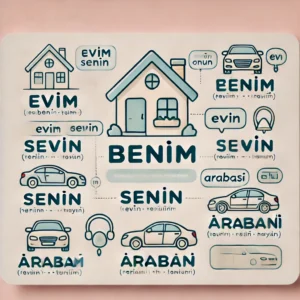
Understanding Possessive Suffixes in Turkish
In Turkish, possessive suffixes indicate ownership and change based on whether the base noun ends in a consonant or a vowel. The suffix may include an additional vowel to make pronunciation smoother.
General Rules:
1️⃣ If the noun ends in a consonant, a vowel is added before the suffix to make pronunciation smoother.
2️⃣ If the noun ends in a vowel, only a consonant suffix is added, as no extra vowel is needed.
Table: Possessive Suffixes in Turkish
| Subject | Noun | Possessive Form | Explanation |
|---|---|---|---|
| Ben (I) | Ev (house) | Evim (my house) | -im is added because ev ends with a consonant. A vowel (-i-) is used for easier pronunciation. |
| Ben (I) | Araba (car) | Arabam (my car) | -m is added without an extra vowel because araba ends in a vowel. |
| Sen (You) | Ev (house) | Evin (your house) | -in is added after ev to maintain pronunciation flow. |
| Sen (You) | Araba (car) | Araban (your car) | -n is added after araba, since it already ends in a vowel. |
| O (He/She/It) | Ev (house) | Evi (his/her house) | -i is added for simplicity. |
| O (He/She/It) | Araba (car) | Arabası (his/her car) | -sı is added because araba ends in a vowel, requiring a connecting consonant (-s-) for smoother pronunciation. |
Key Takeaways:
✔ Words ending in consonants (e.g., ev) require a connecting vowel before the suffix.
✔ Words ending in vowels (e.g., araba) take only a consonant suffix for possession.
✔ Third-person possession (his/her/its) often requires a buffer consonant (-s-) to make the suffix sound natural.