Ders1-Lesson1
Ben – I:
“Ben” corresponds to the first person pronoun “I” in English. It represents the speaker. For example, “Ben mutluyum” translates to “I am happy.”
Sen – You:
“Sen” corresponds to the second person pronoun “You” in English. It represents the listener or the person being addressed. For example, “Sen güzelsin” translates to “You are beautiful.”
O – He/She/It:
“O” corresponds to the third person pronouns “He” for males, “She” for females, and “It” for inanimate objects or general entities. For example, “O evde” translates to “He/She/It is at home.”
Biz – We:
“Biz” corresponds to the first person plural pronoun “We” in English. It represents the speaker and at least one more person. For example, “Biz çalışıyoruz” translates to “We are working.”
Siz – You:
“Siz” corresponds to the second person pronoun “You” in English, and it can represent both singular and plural meanings. It represents one or more individuals being addressed. For example, “Siz güzel bir ailesiniz” translates to “You are a beautiful family.”
Onlar – They:
“Onlar” corresponds to the third person plural pronoun “They” in English. It represents more than one person or object. For example, “Onlar okulda” translates to “They are at school.”
Ben:
“Ben” is the Turkish pronoun equivalent to “I” in English. It is the first-person singular pronoun, used to refer to oneself.
Example: Ben evdeyim. (I am at home.)
Benim:
“Benim” is the Turkish possessive form equivalent to “My” in English. It is used to indicate ownership, showing that something belongs to the person speaking.
Example: Benim arabam. (My car.)
In the second example, “Ben” corresponds to “I,” and “Benim” corresponds to “My,” indicating possession.
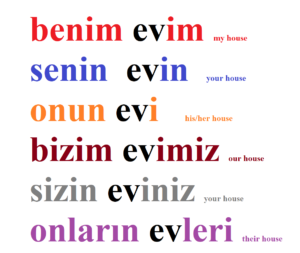
Ben (I) – -im, -ım, -um, -üm
Arabam (My car) – Benim arabam
Sen (You) – -in, -ın, -un, -ün
Kitabın (Your book) – Senin kitabın
O (He/She/It) – -i, -ı, -u, -ü
Evi (His/Her/Its house) – Onun evi
Biz (We) – -imiz, -ımız, -umuz, -ümüz
Okulumuz (Our school) – Bizim okulumuz
Siz (You) – -iniz, -ınız, -unuz, -ünüz
Arabanız (Your car) – Sizin arabınız
Onlar (They) – -leri, -ları
Kitapları (Their book) – Onların kitapları
Sound and syllable harmony is very important in Turkish. That’s why you should always look for the last vowel of the word.
a-e-ı-i-o-ö-u-ü these are the vowels in the Turkish alphabet.
Quizzes are important to you. If you solve the quizzes, your brain will automatically learn this in a short time. It’s okay if you don’t understand. We will talk about the same topics briefly in each lesson. So you will understand the rule in time.
Please solve the quiz below. This quiz will help you learn Turkish sentence structure. You should also learn new words.