Curriculum
- 1 Section
- 60 Lessons
- Lifetime
- Learn Turkish with Sentences (Intermediate language skills)Please study the sentences and grammar structures in detail. Learn new words and solve quizzes. Quizzes will help you learn sentence structure in Turkish and learn new words.62
- 1.1Learn Turkish (Lesson1-Section1-B)
- 1.2Simple Turkish Sentences (Lesson2-Section1-B)
- 1.3Turkish Sentences (Lesson3-Section1-B)
- 1.4Learn Turkish with basic sentences (Lesson4-Section1-B)
- 1.5Learn Turkish with basic sentences (Lesson5-Section1-B)
- 1.6Turkish sentence examples (Lesson6-Section1-B)
- 1.7Learn Turkish with basic sentences (Lesson6-Section2-B)
- 1.8Practice Turkish (Turkish Lesson 7-Section1-B)
- 1.9Turkish dialogues (Turkish Lesson 7-Section2-B)
- 1.10How to Talk About Being Busy in Turkish (Turkish Lesson 7-Section3-B)
- 1.11Turkish Gramer and new words (Turkish Lesson 8-Section1-B)
- 1.12Learn new adjectives in Turkish (Turkish Lesson9-Section1-B)
- 1.13Learn new Turkish words (Turkish Lesson9-Section2-B)
- 1.14Speak Turkish ( Lesson10-Section1-B)
- 1.15Turkish Travel Conversations (Turkish Lesson10-Section2-B)
- 1.16Ask questions in Turkish (Turkish Lesson11-Section-1-B)
- 1.17Practice speaking Turkish (Turkish Lesson11-Section-2-B)
- 1.18Turkish Lesson11-Section-3-B
- 1.19Turkish Lesson11-Section4-B
- 1.20Turkish Lesson12-Section-1-Questions
- 1.21Turkish Lesson12-Section2-B
- 1.22Turkish Lesson13-Section-1-Questions
- 1.23Turkish Lesson14-Questions
- 1.24Turkish Lessn 15-Section1-Questions
- 1.25Turkish Lesson 15-Section2-B
- 1.26Turkish Lesson 16-Section1-B-Turkish Questions About Artificial İntellegent
- 1.27Turkish Lesson-16-Answers
- 1.28Turkish Lesson 16-section3-Answers
- 1.29Turkish Lesson 17-Section-1-Questions
- 1.30Turkish Lesson 18-Section1
- 1.31Learn Turkish (Turkish history quiz-related expressions) (Lesson 18-S1)4 Questions
- 1.32Turkish quizes lesson 18-B
- 1.33Daily Turkish Phrases (Ask and answer questions in Turkish) (Turkish Lesson 19-B-S1)
- 1.34Daily Turkish Phrases Quiz ( (Turkish Lesson 19-B-S2)10 Minutes4 Questions
- 1.35Turkish Practice (Turkish Lesson 19-B Section 3)
- 1.36Speak Fluent Turkish-Turkish Lesson 20-B
- 1.37Speak Fluent Turkish-Turkish Lesson 20-B -Quiz1
- 1.38Speak Fluent Turkish-Turkish Lesson 21-B
- 1.39Speak Fluent Turkish-Turkish Lesson 21-B-Quizes
- 1.40Speak Turkish Fluenty-Turkish Lesson 22-B
- 1.41Speak Turkish Fluenty-Turkish Lesson 22-B-Quizes
- 1.42Speak Turkish Fluenty-Turkish Lesson 23-B
- 1.43Speak Turkish Fluenty-Turkish Lesson 23-B-Quiz
- 1.44Speak Turkish Fluenty-Turkish Lesson-25-B
- 1.45Speak Turkish Fluenty-Turkish Lesson-26-B
- 1.46Turkish Dialogues-Turkish Lesson-27-B
- 1.47Turkish Dialogues-Turkish Lesson-27-B-Quizes
- 1.48Turkish Dialogues-Turkish Lesson-28-B
- 1.49Turkish Dialogues-Turkish Lesson-29-B
- 1.50Turkish Dialogues-Turkish Lesson-29-B-Quizes
- 1.51Speak Turkish Fluenty-Turkish Lesson-30-B
- 1.52Speak Turkish Fluenty-Turkish Lesson-31-B-Sentences
- 1.53Speak Turkish Fluenty -Turkish Lesson 31-b-B2-Sentences
- 1.54Speak Turkish Fluenty -Turkish Lesson 31-B3-Sentences
- 1.55Speak Turkish Fluenty -Turkish Lesson 32-B-Sentences
- 1.56Learn Turkish Fast-Turkish Lesson 32-B1
- 1.57Learn Turkish Fast-Turkish Lesson 33-B1
- 1.58Learn new Turkish words and grammer-33-B2
- 1.59Learn Turkish and new words-34-B1
- 1.60Turkish Examples-34-B2 (The pattern ”should have” in Turkish)
- 1.61Learn new Turkish Words about kitchen-35-B1
- 1.62Learn Turkish words about kitchen -35-B2
Turkish Lesson14-Questions
Comparing and Expressing Opinions in Turkish
Dünyanın En Tehlikeli Ülkesi Hangisidir?
English: Which is the most dangerous country in the world?
Word Meanings and Sentence Structure:
- dünyanın: of the world (dünya: world, -nın: genitive suffix “of”)
- en tehlikeli: the most dangerous (tehlikeli: dangerous, en: most)
- ülkesi: its country (ülke: country, -si: possessive suffix “its”)
- hangisidir?: which is it? (hangi: which, -dir: is/verb-to-be suffix)
Explanation: This sentence uses en to indicate the superlative (“most”), and -dır gives a formal tone or emphasis.

Fakir ülkeler tehlikeli olabilir.
English: Poor countries can be dangerous.
Word Meanings and Sentence Structure:
- fakir: poor
- ülkeler: countries (ülke: country, -ler: plural suffix)
- tehlikeli: dangerous
- olabilir: can be (olmak: to be, -abilir: can)
Explanation: The -abilir suffix expresses possibility or ability, translating to “can” in English.
Zengin ülkeler tehlikeli değil mi?
English: Aren’t wealthy countries dangerous?
Word Meanings and Sentence Structure:
- zengin: wealthy
- ülkeler: countries
- tehlikeli değil: not dangerous (tehlikeli: dangerous, değil: not)
- mi?: question particle
Explanation: The negative verb değil is used to negate the adjective “dangerous,” and the question particle mi creates a yes/no question.
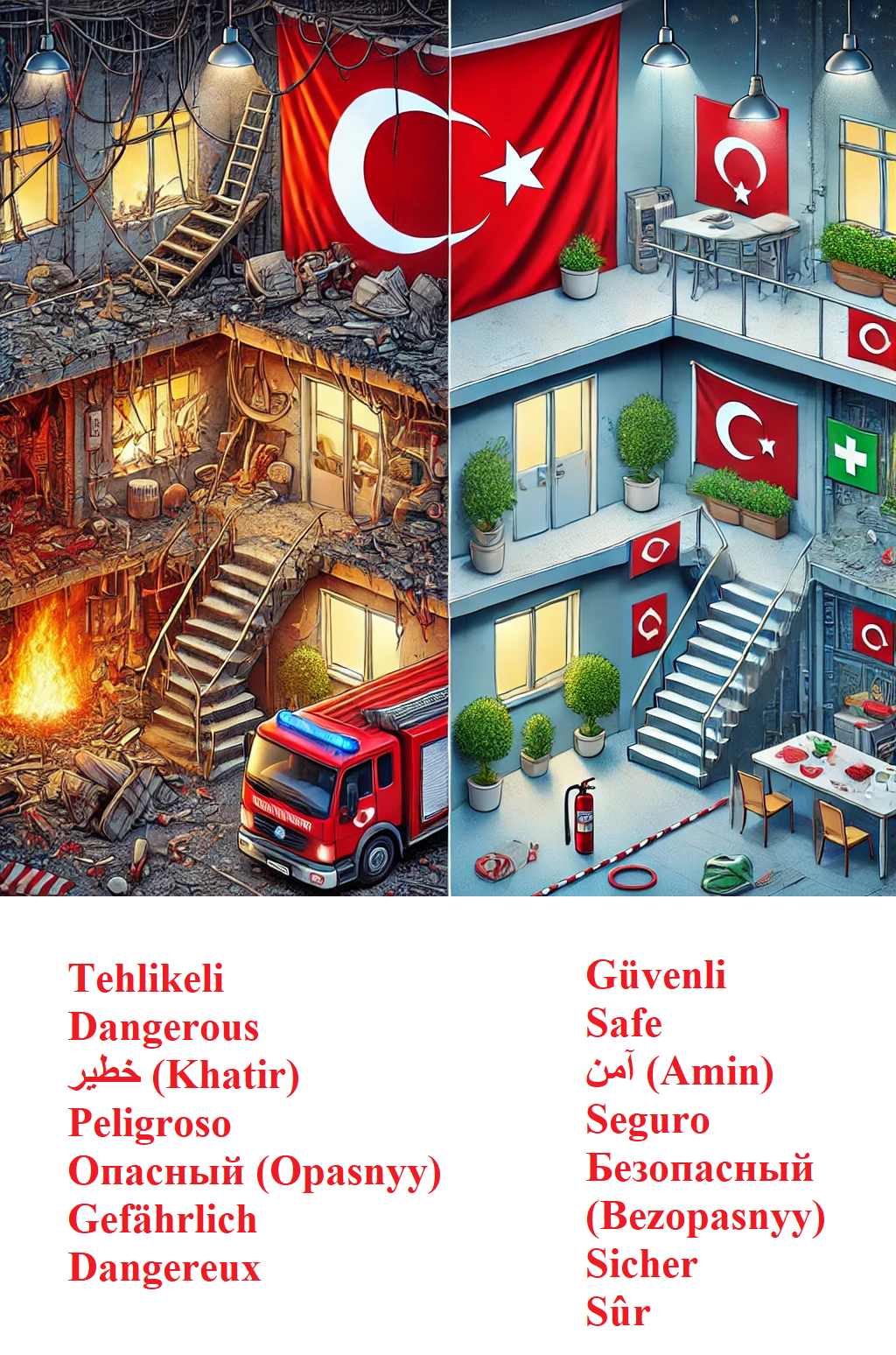
Zengin ülkeler tehlikeli değil.
English: Wealthy countries are not dangerous.
Word Meanings and Sentence Structure:
- zengin: wealthy
- ülkeler: countries
- tehlikeli değil: not dangerous
Explanation: This declarative sentence simply negates the statement without a question particle.
Baban New York’ta mı çalışıyordu?
English: Was your father working in New York?
Word Meanings and Sentence Structure:
- baban: your father (baba: father, -n: possessive suffix “your”)
- New York’ta: in New York (-ta: locative suffix “in”)
- mı: question particle
- çalışıyordu: was working (çalışmak: to work, -ıyor: present continuous, -du: past tense)
Explanation: The combination of -yor (continuous action) and -du (past tense) creates the past continuous tense.
Dünyanın en başarılı ülkesi hangisidir?
English: Which is the most successful country in the world?
Word Meanings and Sentence Structure:
- dünyanın: of the world
- en başarılı: the most successful (başarılı: successful, en: most)
- ülkesi: its country
- hangisidir?: which is it?
Explanation: Similar to “most dangerous,” this sentence uses en for the superlative and -dır for emphasis.

Bence en başarılı ülke İsveç.
English: I think the most successful country is Sweden.
Word Meanings and Sentence Structure:
- bence: in my opinion
- en başarılı: the most successful
- ülke: country
- İsveç: Sweden
Explanation: The phrase bence introduces a personal opinion.
Sence en disiplinli ülke hangisi?
English: In your opinion, which is the most disciplined country?
Word Meanings and Sentence Structure:
- sence: in your opinion
- en disiplinli: the most disciplined
- ülke: country
- hangisi?: which one
Explanation: The phrase sence is the second-person equivalent of bence for opinions.
Bence Kuzey ülkeleri daha disiplinli.
English: I think Northern countries are more disciplined.
Word Meanings and Sentence Structure:
- bence: in my opinion
- Kuzey ülkeleri: Northern countries (Kuzey: North, ülkeler: countries)
- daha disiplinli: more disciplined (daha: more, disiplinli: disciplined)
Explanation: The word daha is used for the comparative form, meaning “more.”
Japonya Fransa’dan daha disiplinli.
English: Japan is more disciplined than France.
Word Meanings and Sentence Structure:
- Japonya: Japan
- Fransa’dan: than France (Fransa: France, -dan: ablative suffix “than/from”)
- daha disiplinli: more disciplined
Explanation: The ablative suffix -dan indicates comparison (“than”), while daha forms the comparative degree.
Lesson Summary
In this lesson, students learned how to use comparative and superlative forms in Turkish using words like daha (“more”) and en (“most”). They also practiced forming questions with mi and using the ablative suffix (-dan) for comparisons. Additionally, the lesson included forming opinions with bence and sence, and using -yor + du to express past continuous tense.
10 Keywords for SEO
- Turkish comparative grammar
- Turkish superlative structure
- Ablative suffix in Turkish
- Turkish opinion phrases
- Turkish past continuous tense
- Learn Turkish questions
- Turkish for beginners
- Comparing countries in Turkish
- Turkish sentence structure
- Turkish adjectives and suffixes